


Page 65 - Revista Portuguesa - SPORL - Vol 63. Nº2
P. 65
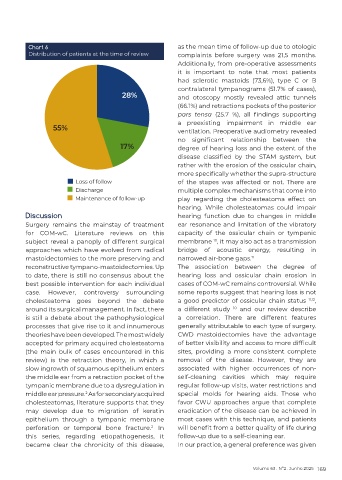
Chart 6                                           as the mean time of follow-up due to otologic
          Distribution of patients at the time of review    complaints before surgery was 21,5 months.
                                                            Additionally, from pre-operative assessments
                                                            it is important to note that most patients
                                                            had sclerotic mastoids (73,6%), type C or B
                                                            contralateral tympanograms (51.7% of cases),
                                                            and otoscopy mostly revealed attic tunnels
                                                            (66.1%) and retractions pockets of the posterior
                                                            pars  tensa  (25.7  %),  all  findings  supporting
                                                            a preexisting impairment in  middle ear
                                                            ventilation. Preoperative audiometry revealed
                                                            no  significant  relationship  between  the
                                                            degree of hearing loss and the extent of the
                                                            disease  classified  by  the  STAM  system,  but
                                                            rather with the erosion of the ossicular chain,
                                                            more specifically whether the supra-structure
                                                            of the stapes was affected or not. There are
                                                            multiple complex mechanisms that come into
                                                            play regarding the cholesteatoma effect on
                                                            hearing. While cholesteatomas could impair
          Discussion                                        hearing function due to changes in middle
          Surgery remains the mainstay of treatment         ear resonance and limitation of the vibratory
          for COM-wC. Literature reviews on this            capacity  of  the  ossicular  chain  or  tympanic
          subject reveal a panoply of different surgical    membrane  , it may also act as a transmission
                                                                        10
          approaches which have evolved from radical        bridge of acoustic energy, resulting in
          mastoidectomies to the more preserving and        narrowed air-bone gaps.
                                                                                    11
          reconstructive tympano-mastoidectomies. Up        The  association between the degree of
          to date, there is still no consensus about the    hearing loss and ossicular chain erosion in
          best possible intervention for each individual    cases of COM-wC remains controversial. While
          case.  However,    controversy   surrounding      some reports suggest that hearing loss is not
          cholesteatoma goes beyond the debate              a good predictor of ossicular chain status  11,12 ,
          around its surgical management. In fact, there    a different study   and our review  describe
                                                                              10
          is still a debate about the pathophysiological    a correlation. There are different features
          processes that give rise to it and innumerous     generally attributable to each type of surgery.
          theories have been developed. The most widely     CWD mastoidectomies have the advantage
          accepted for primary acquired cholesteatoma       of better visibility and access to more difficult
          (the main bulk of cases encountered in this       sites, providing a more consistent complete
          review) is the retraction theory, in which a      removal of the disease. However, they are
          slow ingrowth of squamous epithelium enters       associated with higher occurrences of non-
          the middle ear from a retraction pocket of the    self-cleaning  cavities  which  may  require
          tympanic membrane due to a dysregulation in       regular follow-up visits, water restrictions and
          middle ear pressure.  As for secondary acquired   special molds for hearing aids. Those who
                             2
          cholesteatomas, literature supports that they     favor CWU approaches argue that complete
          may  develop  due  to  migration  of  keratin     eradication of the disease can be achieved in
          epithelium through a tympanic membrane            most cases with this technique, and patients
          perforation or temporal bone fracture.   In       will benefit from a better quality of life during
                                                   2
          this  series,  regarding  etiopathogenesis,  it   follow-up due to a self-cleaning ear.
          became clear the chronicity of this disease,      In our practice, a general preference was given


                                                                                     Volume 63 . Nº2 . Junho 2025 169

