


Page 64 - Revista Portuguesa - SPORL - Vol 63. Nº2
P. 64
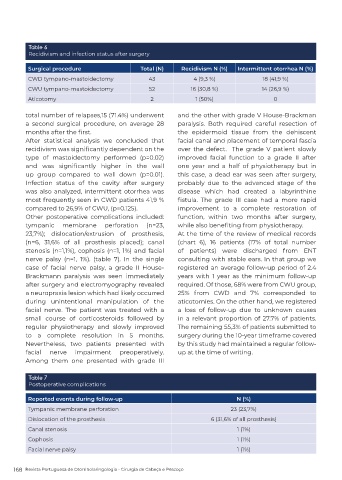
Table 6
          Recidivism and infection status after surgery

          Surgical procedure                    Total (N)    Recidivism N (%)   Intermittent otorrhea N (%)

          CWD tympano-mastoidectomy               43             4 (9,3 %)              18 (41,9 %)
          CWU tympano-mastoidectomy               52            16 (30,8 %)             14 (26,9 %)
          Aticotomy                                2              1 (50%)                   0

          total number of relapses,15 (71.4%) underwent     and the other with grade V House-Brackman
          a second surgical procedure, on average 28        paralysis. Both required careful resection of
          months after the first.                           the epidermoid tissue from the dehiscent
          After statistical analysis we concluded that      facial canal and placement of temporal fascia
          recidivism was significantly dependent on the     over the defect.  The grade V patient slowly
          type of mastoidectomy performed (p=0.02)          improved  facial  function  to a  grade  II  after
          and  was  significantly  higher  in  the  wall    one year and a half of physiotherapy but in
          up group compared to wall down (p=0.01).          this case, a dead ear was seen after surgery,
          Infection status of the cavity after surgery      probably due to the advanced stage of the
          was also analyzed, intermittent otorrhea was      disease which had created a labyrinthine
          most frequently seen in CWD patients 41,9 %       fistula.  The  grade  III  case  had  a  more  rapid
          compared to 26,9% of CWU, (p=0.125).              improvement to a complete restoration of
          Other postoperative complications included:       function, within two months after surgery,
          tympanic    membrane      perforation   (n=23,    while also benefiting from physiotherapy.
          23,7%); dislocation/extrusion of prosthesis,      At the time of the review of medical records
          (n=6, 31,6% of all prosthesis placed); canal      (chart 6), 16 patients (17% of total number
          stenosis (n=1,1%), cophosis (n=1, 1%) and facial   of patients) were discharged from ENT
          nerve palsy (n=1, 1%). (table 7). In the single   consulting with stable ears. In that group we
          case of facial nerve palsy, a grade II House-     registered an average follow-up period of 2.4
          Brackmann paralysis was seen immediately          years with 1 year as the minimum follow-up
          after surgery and electromyography revealed       required. Of those, 68% were from CWU group,
          a neuropraxia lesion which had likely occurred    25% from CWD and 7% corresponded to
          during unintentional manipulation of the          aticotomies. On the other hand, we registered
          facial nerve. The patient was treated with a      a loss of follow-up due to unknown causes
          small course of corticosteroids followed by       in a relevant proportion of 27.7% of patients.
          regular physiotherapy and slowly improved         The remaining 55,3% of patients submitted to
          to a complete resolution in 5 months.             surgery during the 10-year timeframe covered
          Nevertheless, two patients presented with         by this study had maintained a regular follow-
          facial  nerve   impairment     preoperatively.    up at the time of writing.
          Among them one presented with grade III

          Table 7
          Postoperative complications

          Reported events during follow-up                                     N (%)
          Tympanic membrane perforation                                       23 (23,7%)
          Dislocation of the prosthesis                                6 (31,6% of all prosthesis)
          Canal stenosis                                                        1 (1%)
          Cophosis                                                              1 (1%)
          Facial nerve palsy                                                    1 (1%)


      168  Revista Portuguesa de Otorrinolaringologia - Cirurgia de Cabeça e Pescoço

