


Page 60 - Revista Portuguesa - SPORL - Vol 63. Nº2
P. 60
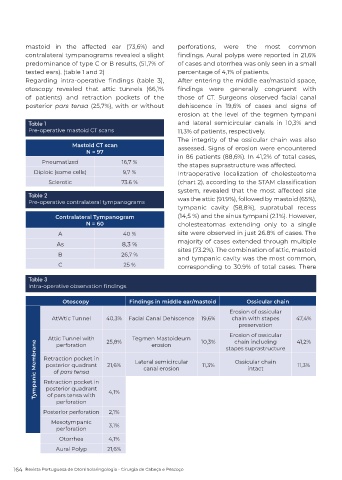
mastoid in the affected ear (73,6%) and            perforations,  were    the   most    common
         contralateral tympanograms revealed a slight       findings. Aural polyps were reported in 21,6%
         predominance of type C or B results, (51,7% of     of cases and otorrhea was only seen in a small
         tested ears). (table 1 and 2)                      percentage of 4,1% of patients.
         Regarding  intra-operative  findings  (table  3),   After entering the middle ear/mastoid space,
         otoscopy revealed that attic tunnels (66,1%        findings  were  generally  congruent  with
         of patients) and retraction pockets of the         those of CT.  Surgeons observed facial canal
         posterior  pars  tensa (25,7%), with or without    dehiscence in 19,6% of cases and signs of
                                                            erosion at the level of the tegmen tympani
          Table 1                                           and lateral semicircular canals in 10,3% and
          Pre-operative mastoid CT scans                    11,3% of patients, respectively.
                                                            The integrity of the ossicular chain was also
                         Mastoid CT scan
                              N = 97                        assessed. Signs of erosion were encountered
                                                            in 86 patients (88,6%). In 41,2% of total cases,
               Pneumatized               16,7 %
                                                            the stapes suprastructure was affected.
            Diploic (some cells)          9,7 %             Intraoperative localization of cholesteatoma
                 Sclerotic               73.6 %             (chart 2), according to the STAM classification
                                                            system,  revealed  that  the  most  affected  site
          Table 2
          Pre-operative contralateral tympanograms          was the attic (91.9%), followed by mastoid (65%),
                                                            tympanic  cavity  (58,8%),  supratubal  recess
                   Contralateral Tympanogram                (14,5 %) and the sinus tympani (2.1%). However,
                              N = 60                        cholesteatomas extending only  to a  single

                    A                     40 %              site were observed in just 26.8% of cases. The
                    As                   8,3 %              majority of cases extended through multiple
                                                            sites (73.2%). The combination of attic, mastoid
                    B                    26,7 %
                                                            and tympanic cavity was the most common,
                    C                     25 %              corresponding to 30.9% of total cases. There

          Table 3
          Intra-operative observation findings


                      Otoscopy              Findings in middle ear/mastoid         Ossicular chain
                                                                             Erosion of ossicular
                  AtWtic Tunnel     40,3%   Facial Canal Dehiscence  19,6%    chain with stapes    47,4%
                                                                                preservation
                                                                             Erosion of ossicular
                 Attic Tunnel with  25,8%    Tegmen Mastoideum      10,3%   stapes suprastructure  41,2%
                                                                               chain including
             Tympanic Membrane  Retraction pocket in  21,6%  Lateral semicircular   11,3%  Ossicular chain  11,3%
                                                   erosion
                    perforation
                posterior quadrant
                                                                                   intact
                                                 canal erosion
                   of pars tensa
                Retraction pocket in
                posterior quadrant
                 of pars tensa with
                    perforation      4,1%
               Posterior perforation  2,1%
                  Mesotympanic
                    perforation      3,1%
                     Otorrhea        4,1%
                    Aural Polyp      21,6%


      164  Revista Portuguesa de Otorrinolaringologia - Cirurgia de Cabeça e Pescoço

