


Page 112 - Revista Portuguesa - SPORL - Vol 60. Nº3
P. 112
Arytnoid subluxation/dislocation is caused by     balanced  general  anesthesia  with  laryngeal
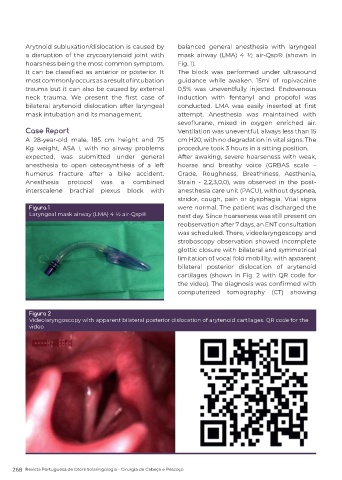
          a disruption of the crycoarytenoid joint with     mask  airway  (LMA)  4  ½  air-Qsp®  (shown  in
          hoarsness being the most common symptom.          Fig. 1).
          It can be classified as anterior or posterior. It   The  block  was  performed  under  ultrasound
          most commonly occurs as a result of intubation    guidance  while  awaken.  15ml  of  ropivacaine
          trauma but it can also be caused by external      0,5% was uneventfully injected. Endovenous
          neck  trauma.  We  present  the  first  case  of   induction with fentanyl and propofol was
          bilateral arytenoid dislocation after laryngeal   conducted.  LMA  was  easily  inserted  at  first
          mask intubation and its management.               attempt. Anesthesia was maintained with
                                                            sevoflurane,  mixed  in  oxygen  enriched  air.
          Case Report                                       Ventilation was uneventful, always less than 15
          A 28-year-old male, 185 cm height and 75          cm H20, with no degradation in vital signs. The
          Kg weight, ASA I, with no airway problems         procedure took 3 hours in a sitting position.
          expected,  was  submitted  under  general         After  awaking,  severe  hoarseness  with  weak,
          anesthesia to open osteosynthesis of a left       hoarse and breathy voice (GRBAS scale –
          humerus  fracture  after  a  bike  accident.      Grade, Roughness, Breathiness, Aesthenia,
          Anesthesia   protocol   was    a   combined       Strain - 2,2,3,0,0), was observed in the post-
          interscalene  brachial  plexus  block  with       anesthesia care unit (PACU), without dyspnea,
                                                            stridor, cough, pain or dysphagia. Vital signs
           Figura 1                                         were normal. The patient was discharged the
           Laryngeal mask airway (LMA) 4 ½ air-Qsp®         next day. Since hoarseness was still present on
                                                            reobservation after 7 days, an ENT consultation
                                                            was scheduled. There, videolaryngoscopy and
                                                            stroboscopy observation showed incomplete
                                                            glottic closure with bilateral and symmetrical
                                                            limitation of vocal fold mobility, with apparent
                                                            bilateral posterior dislocation of arytenoid
                                                            cartilages (shown in Fig. 2 with QR code for
                                                            the video). The diagnosis was confirmed with
                                                            computerized tomography (CT) showing


           Figura 2
           Videolaryngoscopy with apparent bilateral posterior dislocation of arytenoid cartilages. QR code for the
           video


     268  Revista Portuguesa de Otorrinolaringologia - Cirurgia de Cabeça e Pescoço

