


Page 21 - Portuguese Journal - SPORL - Vol 61. Nº1
P. 21
of  children  with  adenotonsillar  hypertrophy   Conclusion
          and 0% in the control group.                      It can be concluded that there was a significant
                                      10
          Gregório et al. (2008) conducted a polygraphic    reduction in bruxism after surgery because 17
          sleep study on 38 children diagnosed with         (77%) of the 23 children who had bruxism no
          OSAS and found the presence of bruxism in         longer exhibited it after tonsil and adenoid
          34.3% of them. 11                                 removal.
          In another study by Grechi  et al. (2008), 60     The knowledge of this association can enable
          children with nasal congestion, aged between      pediatricians and dentists to refer children to
          two and 23 years were evaluated, and the          the specialty of otorhinolaryngology (ORL) for
          results showed that 65.2% had bruxism.  12        the investigation of OSRBD in cases of bruxism
          Similarly, Ferreira et al. (2014) reported that in   and also encourage otorhinolaryngologists to
          a sample of children with bruxism, 11.03% also    investigate complaints of bruxism in children
          had OSAS. 13                                      with OSRBD.
          Thus,  there are  several published  studies      In conclusion, a combination of ORL and
          in which a positive association between           orthodontics consultations is important for
          OSRBD and sleep bruxism was observed and          optimal evaluation and therapeutic decision-
          the prevalence of bruxism in children with        making in cases of bruxism in the pediatric
          adenotonsillar hypertrophy varied between         population.
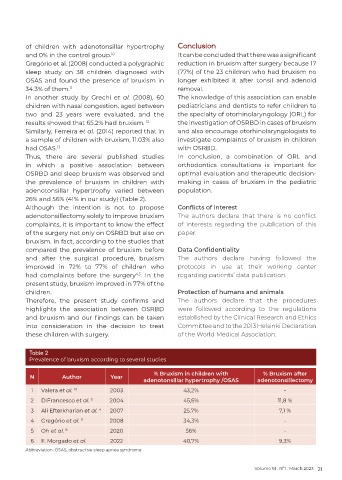
          26% and 56% (41% in our study) (Table 2).
          Although the intention is not to propose          Conflicts of Interest
          adenotonsillectomy solely to improve bruxism      The  authors  declare  that  there  is  no  conflict
          complaints, it is important to know the effect    of interests regarding the publication of this
          of the surgery not only on OSRBD but also on      paper.
          bruxism. In fact, according to the studies that
          compared the prevalence of bruxism before         Data Confidentiality
          and after the surgical procedure, bruxism         The authors declare having followed the
          improved  in  72%  to 77%  of  children  who      protocols in use at their working center
          had complaints before the surgery . In the        regarding patients’ data publication.
                                              4,5
          present study, bruxism improved in 77% of the
          children.                                         Protection of humans and animals
          Therefore,  the  present  study  confirms  and    The authors declare  that the procedures
          highlights the association between OSRBD          were followed according to the regulations
          and  bruxism  and  our  findings  can  be  taken   established by the Clinical Research and Ethics
          into consideration in the decision to treat       Committee and to the 2013 Helsinki Declaration
          these children with surgery.                      of the World Medical Association.


           Table 2
           Prevalence of bruxism according to several studies
                                                    % Bruxism in children with          % Bruxism after
           N          Author          Year
                                                 adenotonsillar hypertrophy /OSAS     adenotonsillectomy
           1   Valera et al.  10     2003                     43,2%                            -
           2   DiFrancesco et al.  5  2004                    45,6%                          11,8 %
           3   Ali Efterkharian et al.  4  2007               25,7%                           7,1 %
           4   Gregório et al.  11   2008                     34,3%                            -
           5   Oh et al.  8          2020                      56%                             -
           6   F. Morgado et al.      2022                    40,7%                           9,3%
          Abbreviation: OSAS, obstructive sleep apnea syndrome


                                                                                     Volume 61 . Nº1 . March 2023 21

