


Page 19 - Portuguese Journal - SPORL - Vol 61. Nº1
P. 19
There   are    several   theories   on    the     caregiver during a period of time that varied
          pathophysiology  of  this  association:  children   from three to 12 months after surgery.
          with apnea have frequent nocturnal micro-         The inclusion criteria were children aged
          arousals associated with an increase in           between  two  and  12 years  with  a clinical
          parafunctional activity, including masticatory    diagnosis   of   OSRBD     (snoring,   mouth
          activity, with activation of the masticatory      breathing, gaps in breathing, attention deficit,
          muscles that in turn leads to bruxism.       7    daytime sleepiness, hyperactivity), with grade
          Moreover, children with airway obstruction        III or IV tonsillar hypertrophy according to the
          place their jaws in a more anterior position      Brodsky classification.
          to improve the patency of  the  airway,  which    The exclusion criteria were as follows: children
          stimulates receptors and increases  the tone      with a personal or family history of cleft palate
          of the upper airways.   8  In addition, mouth     or other craniofacial syndromes, children
          breathing can interfere with the sleep cycle      currently undergoing or having previously
          and affect brain oxygenation, thereby causing     undergone     orthodontic    treatment,   and
          involuntary contraction of the facial muscles.  8  children  whose  caregivers  were unaware  of
          The objective of the present study was to         bruxism.
          determine the prevalence of bruxism in
          children   with   obstructive   sleep-related     Results
          breathing  disorders  (OSRBD)  and  evaluate      Between January and November 2021, 54
          the impact of adenotonsillectomy on the           children with a mean age of 6.7 ± 2.6 years
          improvement or resolution of the disorder.        underwent adenotonsillectomy due to a sleep
                                                            breathing disorder.
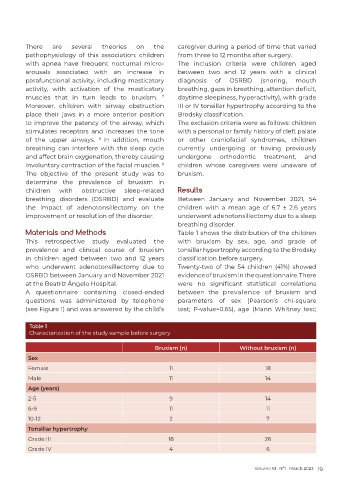
          Materials and Methods                             Table 1 shows the distribution of the children
          This retrospective study evaluated the            with bruxism by sex, age, and grade of
          prevalence and clinical course of bruxism         tonsillar hypertrophy according to the Brodsky
          in children aged between two and 12 years         classification before surgery.
          who underwent adenotonsillectomy due to           Twenty-two of the 54 children (41%) showed
          OSRBD between January and November 2021           evidence of bruxism in the questionnaire. There
          at the Beatriz Ângelo Hospital.                   were  no  significant  statistical  correlations
          A questionnaire containing closed-ended           between the  prevalence of bruxism and
          questions was administered by telephone           parameters of sex (Pearson’s chi-square
          (see Figure 1) and was answered by the child’s    test; P-value=0.65), age (Mann Whitney test;


           Table 1
           Characterization of the study sample before surgery

                                                    Bruxism (n)                 Without bruxism (n)
          Sex
          Female                                         11                              18
          Male                                           11                              14

          Age (years)
          2-5                                            9                               14
          6-9                                            11                              11
          10-12                                          2                               7
          Tonsillar hypertrophy
          Grade III                                      18                              26
          Grade IV                                       4                               6


                                                                                     Volume 61 . Nº1 . March 2023 19

