


Page 20 - Portuguese Journal - SPORL - Vol 61. Nº1
P. 20
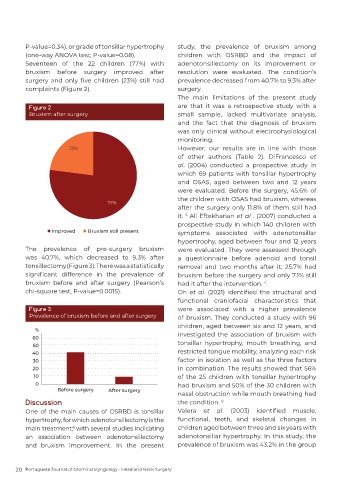
P-value=0.34), or grade of tonsillar hypertrophy   study, the prevalence of  bruxism among
         (one-way ANOVA test; P-value=0.08).                children with  OSRBD  and the impact of
         Seventeen of the 22 children (77%) with            adenotonsillectomy  on its improvement or
         bruxism before surgery improved after              resolution were evaluated. The condition’s
         surgery  and  only  five  children  (23%)  still  had   prevalence decreased from 40.7% to 9.3% after
         complaints (Figure 2).                             surgery.
                                                            The main limitations of the present study

           Figure 2                                         are that  it was a retrospective study  with a
           Bruxism after surgery                            small  sample,  lacked  multivariate  analysis,
                                                            and  the  fact that  the  diagnosis  of  bruxism
                                                            was only clinical without electrophysiological
                                                            monitoring.
                                                            However,  our  results are  in  line with  those
                                                            of other authors (Table 2). DiFrancesco  et
                                                            al. (2004) conducted a prospective study in
                                                            which 69 patients with tonsillar hypertrophy
                                                            and OSAS, aged between two and 12 years
                                                            were evaluated. Before the surgery, 45.6% of
                                                            the children with OSAS had bruxism, whereas
                                                            after the surgery only 11.8% of them still had
                                                            it.   Ali Eftekharian et al . (2007) conducted a
                                                              5
                                                            prospective study in which 140 children with
                                                            symptoms associated with adenotonsillar
                                                            hypertrophy, aged between four and 12 years
         The  prevalence of pre-surgery bruxism             were evaluated. They were assessed through
         was 40.7%, which decreased to 9.3% after           a questionnaire before adenoid and tonsil
         tonsillectomy (Figure 3). There was a statistically   removal and two months after it; 25.7% had
         significant  difference  in  the  prevalence of    bruxism before the surgery and only 7.1% still
         bruxism before and after surgery (Pearson’s        had it after the intervention.  4
         chi-square test, P-value=0.0015).                  Oh  et al.  (2021)  identified  the  structural  and
                                                            functional craniofacial characteristics that
           Figure 3                                         were associated with a higher prevalence
           Prevalence of bruxism before and after surgery     of bruxism. They conducted a study with 96
                                                            children, aged between six and 12 years, and
                                                            investigated the  association of  bruxism with
                                                            tonsillar hypertrophy, mouth breathing, and
                                                            restricted tongue mobility, analyzing each risk
                                                            factor in isolation as well as the three factors
                                                            in combination. The results showed that 56%
                                                            of  the  25  children  with  tonsillar  hypertrophy
                                                            had bruxism and 50% of the 30 children with
                                                            nasal obstruction while mouth breathing had
         Discussion                                         the condition.  8
         One of the main causes of OSRBD is tonsillar       Valera  et  al.  (2003)  identified  muscle,
         hypertrophy, for which adenotonsillectomy is the   functional, teeth, and skeletal changes in
         main treatment; with several studies indicating    children aged between three and six years with
                         6
         an association between adenotonsillectomy          adenotonsillar hypertrophy. In this study, the
         and  bruxism  improvement.  In  the  present       prevalence of bruxism was 43.2% in the group


      20  Portuguese Journal of Otorhinolaryngology - Head and Neck Surgery

