


Page 18 - Portuguese Journal - SPORL - Vol 61. Nº1
P. 18
teeth or hypertrophy of the masticatory           epilepsy; and gastroesophageal reflux disease
          muscles   Bruxism  is often  asymptomatic         (because the stimulation of intraesophageal
                  .2
          and  becomes  clinically  significant  when       acid can induce rhythmic masticatory muscle
          it interferes with sleep or results in dental     activity during sleep and masseter muscle
          erosion, headaches, jaw muscle pain and/or        activity when awake).  In fact, several authors
                                                                                  3
          fatigue, and rigidity or difficulty in opening the   have suggested that OSAS  is the main risk
          jaw upon waking up.   Its main complications      factor for bruxism. In addition, the treatment
                               3
          are the risk of developing symptoms due to        of sleep apnea with continuous positive airway
          temporomandibular changes (muscle and             pressure (CPAP) in adults has been shown to
          joint pain), muscle hypertrophy, dental erosion   improve bruxism.  4,5
          and fractures, and even teeth loss.  3            In children, hypertrophy of the palatine
          The main risk factors for bruxism are: sleep      tonsils and adenoids is the main cause of
          disturbances, such as obstructive sleep apnea     OSAS ; therefore, several studies have been
                                                                  6
          syndrome  (OSAS)  or  parasomnia;  abnormal       conducted to compare  the  prevalence of
          dental occlusion; psychiatric disturbances;       bruxism  before  and  after  tonsil  and  adenoid
          neurologic diseases such as cerebral palsy or     removal surgery.

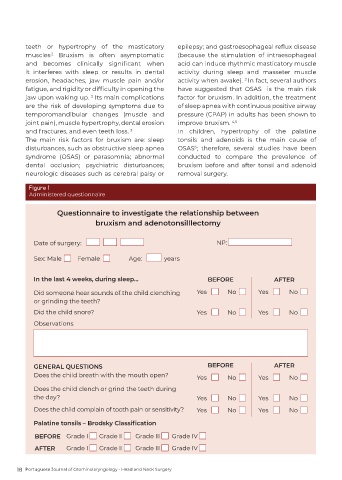
           Figure 1
           Administered questionnaire


       18  Portuguese Journal of Otorhinolaryngology - Head and Neck Surgery

