


Page 95 - Portuguese Journal - SPORL - Vol 61. Nº1
P. 95
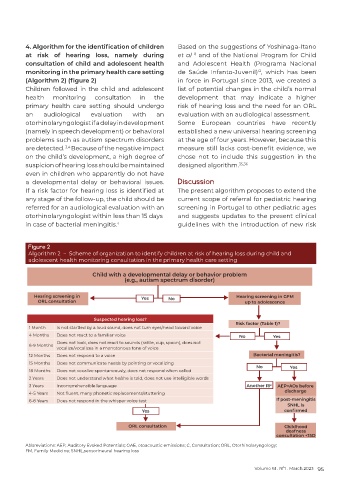
4. Algorithm for the identification of children   Based on the suggestions of Yoshinaga-Itano
          at risk of hearing loss, namely during            et al   and of the National Program for Child
                                                                 8
          consultation of child and adolescent health       and  Adolescent  Health  (Programa  Nacional
          monitoring in the primary health care setting     de Saúde Infanto-Juvenil) , which has been
                                                                                       12
          (Algorithm 2) (figure 2)                          in force in Portugal since 2013, we created a
          Children  followed  in  the  child  and  adolescent   list of potential changes in the child’s normal
          health   monitoring   consultation   in   the     development that may indicate a higher
          primary  health  care setting should undergo      risk of hearing loss and the need for an ORL
          an   audiological    evaluation    with    an     evaluation with an audiological assessment.
          otorhinolaryngologist if a delay in development   Some European countries have recently
          (namely in speech development) or behavioral      established a new universal hearing screening
          problems such as autism spectrum disorders        at the age of four years. However, because this
          are detected.   Because of the negative impact    measure  still  lacks  cost-benefit  evidence,  we
                       3,4
          on the child’s development, a high degree of      chose not to include this suggestion in the
          suspicion of hearing loss should be maintained    designed algorithm. 35,36
          even in children who apparently do not have
          a developmental delay or behavioral issues.       Discussion
          If a risk factor for hearing loss is identified at   The present algorithm proposes to extend the
          any stage of the follow-up, the child should be   current scope of referral for pediatric hearing
          referred for an audiological evaluation with an   screening in Portugal to other pediatric ages
          otorhinolaryngologist within less than 15 days    and suggests updates to the present clinical
          in case of bacterial meningitis. 4                guidelines  with  the  introduction  of  new  risk


          Figure 2
          Algorithm 2  –  Scheme of organization to identify children at risk of hearing loss during child and
          adolescent health monitoring consultation in the primary health care setting


                                Suspected hearing loss?
           1 Month  Is not startled by a loud sound, does not turn eyes/head toward voice
           4 Months  Does not react to a familiar voice
                    Does not look, does not react to sounds (rattle, cup, spoon), does not
           6-9 Months
                    vocalize/vocalizes in a monotonous tone of voice
           12 Months  Does not respond to a voice
           15 Months  Does not communicate needs by pointing or vocalizing
           18 Months  Does not vocalize spontaneously, does not respond when called
           2 Years  Does not understand what he/she is told, does not use intelligible words
           3 Years  Incomprehensible language
           4-5 Years  Not fluent, many phonetic replacements/stuttering
           6-8 Years  Does not respond in the whisper voice test


         Abbreviations: AEP, Auditory Evoked Potentials; OAE, otoacoustic emissions; C, Consultation; ORL, Otorhinolaryngology;
         FM, Family Medicine; SNHL,sensorineural hearing loss


                                                                                     Volume 61 . Nº1 . March 2023 95

