


Page 93 - Portuguese Journal - SPORL - Vol 61. Nº1
P. 93
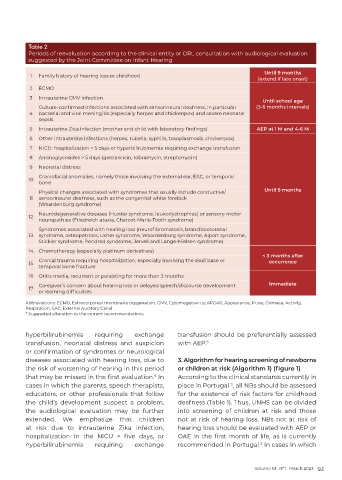
Table 2
          Periods of reevaluation according to the clinical entity or ORL consultation with audiological evaluation
          suggested by the Joint Committee on Infant Hearing
                                                                                         Until 9 months
           1  Family history of hearing loss in childhood
                                                                                       (extend if late onset)
           2  ECMO
           3  Intrauterine CMV infection
                                                                                        Until school age
              Culture-confirmed infections associated with sensorineural deafness, in particular  (3-6 months intervals)
           4  bacterial and viral meningitis (especially herpes and chickenpox) and severe neonatal
              sepsis
           5  Intrauterine Zica infection (mother and child with laboratory findings)  AEP at 1 M and 4-6 M
           6  Other intrauterine infections (herpes, rubella, syphilis, toxoplasmosis, chickenpox)
           7  NICU: hospitalization > 5 days or hyperbilirubinemia requiring exchange transfusion
           8  Aminoglycosides > 5 days (gentamicin, tobramycin, streptomycin)
           9  Neonatal distress
              Craniofacial anomalies, namely those involving the external ear, EAC, or temporal
          10
              bone
              Physical changes associated with syndromes that usually include conductive/  Until 9 months
           11  sensorineural deafness, such as the congenital white forelock
              (Waardenburg syndrome)
              Neurodegenerative diseases (Hunter syndrome, leukodystrophies) or sensory-motor
           12
              neuropathies (Friedreich ataxia, Charcot-Marie-Tooth syndrome)
              Syndromes associated with hearing loss (neurofibromatosis, branchiootorenal
           13  syndrome, osteopetrosis, Usher syndrome, Waardenburg syndrome, Alport syndrome,
              Stickler syndrome, Pendred syndrome, Jervell and Lange-Nielsen syndrome)
           14  Chemotherapy (especially platinum derivatives)
                                                                                        < 3 months after
              Cranial trauma requiring hospitalization, especially involving the skull base or  occurrence
           15
              temporal bone fracture
           16  Otitis media, recurrent or persisting for more than 3 months
              Caregiver’s concern about hearing loss or delayed speech/discourse development  Immediate
           17
              or learning difficulties
          Abbreviations: ECMO, Extracorporeal membrane oxygenation; CMV, Cytomegalovirus; APGAR, Appearance, Pulse, Grimace, Activity,
          Respiration; EAC, External Auditory Canal
          * Suggested alteration to the current recommendations.


          hyperbilirubinemia     requiring    exchange      transfusion should be preferentially assessed
          transfusion,  neonatal  distress  and  suspicion   with AEP. 6
          or confirmation of syndromes or neurological
          diseases associated with hearing loss, due to     3. Algorithm for hearing screening of newborns
          the risk of worsening of hearing in this period   or children at risk (Algorithm 1) (figure 1)
          that may be missed in the first evaluation.  In   According to the clinical standards currently in
                                                    6
          cases in which the parents, speech therapists,    place in Portugal  , all NBs should be assessed
                                                                              2
          educators, or other professionals that follow     for the existence of risk factors for childhood
          the child’s development suspect a problem,        deafness (Table 1). Thus, UNHS can be divided
          the  audiological evaluation may  be further      into screening of children at risk and those
          extended.  We  emphasize  that  children          not at risk of hearing loss. NBs not at risk of
          at risk due to intrauterine Zika infection,       hearing loss should be evaluated with AEP or
          hospitalization  in  the  NICU  >  five  days,  or   OAE in the first month of life, as is currently
          hyperbilirubinemia     requiring    exchange      recommended in Portugal.  In cases In which
                                                                                       2


                                                                                     Volume 61 . Nº1 . March 2023 93

