


Page 92 - Portuguese Journal - SPORL - Vol 61. Nº1
P. 92
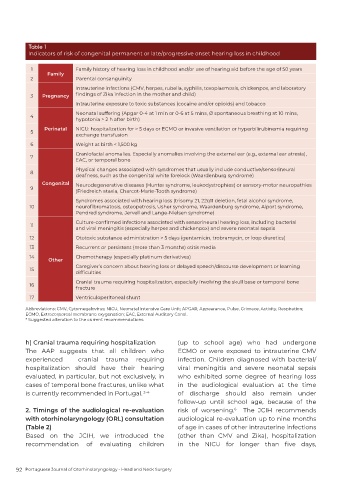
Table 1
          Indicators of risk of congenital permanent or late/progressive onset hearing loss in childhood


           1              Family history of hearing loss in childhood and/or use of hearing aid before the age of 50 years
                 Family
           2              Parental consanguinity
                          Intrauterine infections (CMV, herpes, rubella, syphilis, toxoplasmosis, chickenpox, and laboratory
           3   Pregnancy  findings of Zika infection in the mother and child)
                          Intrauterine exposure to toxic substances (cocaine and/or opioids) and tobacco
                          Neonatal suffering (Apgar 0-4 at 1 min or 0-6 at 5 mins, Ø spontaneous breathing at 10 mins,
           4
                          hypotonia > 2 h after birth)
                Perinatal  NICU: hospitalization for > 5 days or ECMO or invasive ventilation or hyperbilirubinemia requiring
           5
                          exchange transfusion
           6              Weight at birth < 1,500 kg
                          Craniofacial anomalies. Especially anomalies involving the external ear (e.g., external ear atresia),
           7
                          EAC, or temporal bone
                          Physical changes associated with syndromes that usually include conductive/sensorineural
           8
                          deafness, such as the congenital white forelock (Waardenburg syndrome)
               Congenital  Neurodegenerative diseases (Hunter syndrome, leukodystrophies) or sensory-motor neuropathies
           9
                          (Friedreich ataxia, Charcot-Marie-Tooth syndrome)
                          Syndromes associated with hearing loss (trisomy 21, 22q11 deletion, fetal alcohol syndrome,
           10             neurofibromatosis, osteopetrosis, Usher syndrome, Waardenburg syndrome, Alport syndrome,
                          Pendred syndrome, Jervell and Lange-Nielsen syndrome)
                          Culture-confirmed infections associated with sensorineural hearing loss, including bacterial
           11
                          and viral meningitis (especially herpes and chickenpox) and severe neonatal sepsis
           12             Ototoxic substance administration > 5 days (gentamicin, trobramycin, or loop diuretics)
           13             Recurrent or persistent (more than 3 months) otitis media
           14             Chemotherapy (especially platinum derivatives)
                 Other
                          Caregiver’s concern about hearing loss or delayed speech/discourse development or learning
           15
                          difficulties
                          Cranial trauma requiring hospitalization, especially involving the skull base or temporal bone
           16
                          fracture
           17             Ventriculoperitoneal shunt
          Abbreviations: CMV, Cytomegalovirus; NICU, Neonatal Intensive Care Unit; APGAR, Appearance, Pulse, Grimace, Activity, Respiration;
          ECMO, Extracorporeal membrane oxygenation; EAC, External Auditory Canal.
          * Suggested alteration to the current recommendations.


          h) Cranial trauma requiring hospitalization       (up to school age) who had undergone
          The AAP suggests that all children who            ECMO  or  were  exposed  to  intrauterine  CMV
          experienced      cranial  trauma    requiring     infection. Children diagnosed with bacterial/
          hospitalization  should  have  their  hearing     viral meningitis and severe neonatal sepsis
          evaluated, in particular, but not exclusively, in   who exhibited some degree of hearing loss
          cases of temporal bone fractures, unlike what     in the audiological evaluation at the time
          is currently recommended in Portugal.  2–4        of discharge should also remain under
                                                            follow-up until school age, because of the
          2. Timings of the audiological re-evaluation      risk of worsening.   The JCIH recommends
                                                                               6
          with otorhinolaryngology (ORL) consultation       audiological re-evaluation up to nine months
          (Table 2)                                         of age in cases of other intrauterine infections
          Based  on  the  JCIH,  we  introduced  the        (other than CMV and Zika), hospitalization
          recommendation of evaluating children             in  the  NICU  for  longer  than  five  days,


      92  Portuguese Journal of Otorhinolaryngology - Head and Neck Surgery

