


Page 63 - Portuguese Journal - SPORL - Vol 61. Nº1
P. 63
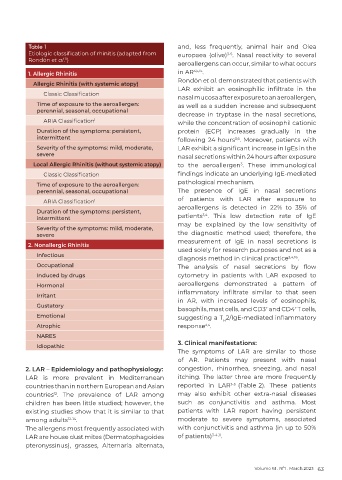
Table 1                                           and, less frequently, animal hair and Olea
          Etiologic classification of rhinitis (adapted from   europaea (olive) . Nasal reactivity to several
                                                                            3-5
          Rondón et al. )
                      11
                                                            aeroallergens can occur, similar to what occurs
          1. Allergic Rhinitis                              in AR 3,5,15 .
                                                            Rondón et al. demonstrated that patients with
            Allergic Rhinitis (with systemic atopy)
                                                            LAR  exhibit  an  eosinophilic  infiltrate  in  the
               Classic Classification
                                                            nasal mucosa after exposure to an aeroallergen,
             Time of exposure to the aeroallergen:          as well as a sudden increase and subsequent
             perennial, seasonal, occupational
                                                            decrease in tryptase in the nasal secretions,
               ARIA Classification 1                        while the concentration of eosinophil cationic
             Duration of the symptoms: persistent,          protein (ECP) increases gradually in the
             intermittent                                   following 24 hours . Moreover, patients with
                                                                               3,6
             Severity of the symptoms: mild, moderate,      LAR exhibit a significant increase in IgEs in the
             severe                                         nasal secretions within 24 hours after exposure
            Local Allergic Rhinitis (without systemic atopy)  to the aeroallergen . These immunological
                                                                                 3
               Classic Classification                       findings indicate an underlying IgE-mediated
             Time of exposure to the aeroallergen:          pathological mechanism.
             perennial, seasonal, occupational              The presence of IgE in nasal secretions
               ARIA Classification 1                        of patients with LAR after exposure to
                                                            aeroallergens is detected in 22% to 35% of
             Duration of the symptoms: persistent,
                                                                    3,4
             intermittent                                   patients . This low detection rate of IgE
                                                            may be explained by the low sensitivity of
             Severity of the symptoms: mild, moderate,
             severe                                         the diagnostic method used; therefore, the
                                                            measurement of IgE in nasal secretions is
          2. Nonallergic Rhinitis
                                                            used solely for research purposes and not as a
             Infectious
                                                            diagnosis method in clinical practice 3,4,16 .
             Occupational                                   The  analysis  of  nasal  secretions  by  flow
             Induced by drugs                               cytometry  in  patients  with  LAR  exposed  to
             Hormonal                                       aeroallergens demonstrated a pattern of
                                                            inflammatory  infiltrate  similar  to  that  seen
             Irritant
                                                            in AR, with increased levels of eosinophils,
             Gustatory
                                                            basophils, mast cells, and CD3  and CD4 T cells,
                                                                                                   +
                                                                                         +
             Emotional                                      suggesting a T 2/IgE-mediated inflammatory
                                                                     3,4
             Atrophic                                       response .     H
             NARES
                                                            3. Clinical manifestations:
             Idiopathic
                                                            The symptoms of LAR are similar to those
                                                            of AR. Patients may present with nasal
          2. LAR – Epidemiology and pathophysiology:        congestion, rhinorrhea, sneezing, and nasal
          LAR is more prevalent in Mediterranean            itching. The latter three are more frequently

          countries than in northern European and Asian     reported in LAR  3-5   (Table 2). These patients
          countries .  The  prevalence  of  LAR  among      may also exhibit other extra-nasal diseases
                   12
          children has been little studied; however, the    such as conjunctivitis and asthma. Most
          existing studies show that it is similar to that   patients with LAR report having persistent
          among adults  12-14 .                             moderate  to  severe  symptoms,  associated
          The allergens most frequently associated with     with conjunctivitis and asthma (in up to 50%
          LAR are house dust mites (Dermatophagoides        of patients) 3-4,11 .
          pteronyssinus), grasses, Alternaria alternata,


                                                                                     Volume 61 . Nº1 . March 2023 63

