


Page 58 - Portuguese Journal - SPORL - Vol 61. Nº1
P. 58
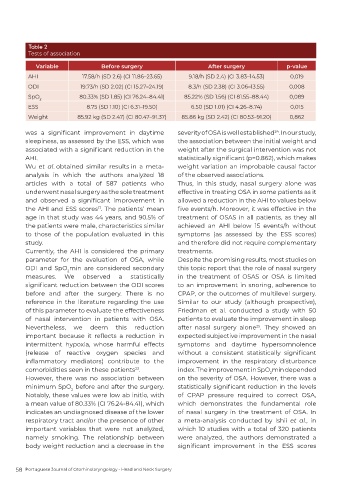
Table 2
          Tests of association

             Variable              Before surgery                     After surgery             p-value
          AHI               17.58/h (SD 2.6) (CI 11.86–23.65)   9.18/h (SD 2.4) (CI 3.83–14.53)  0,019
          ODI               19.73/h (SD 2.02) (CI 15.27–24.19)  8.3/h (SD 2.38) (CI 3.06–13.55)  0,008
          SpO              80.33% (SD 1.85) (CI 76.24–84.41)  85.22% (SD 1.56) (CI 81.55–88.44)   0,089
              2
          ESS                 8.75 (SD 1.10) (CI 6.31–19.50)    6.50 (SD 1.01) (CI 4.26–8.74)    0,015
          Weight           85.92 kg (SD 2.47) (CI 80.47–91.37)   85.86 kg (SD 2.42) (CI 80.53–91.20)   0,862

         was  a  significant  improvement  in  daytime      severity of OSA is well established . In our study,
                                                                                            24
         sleepiness, as assessed by the ESS, which was      the association between the initial weight and
         associated with a significant reduction in the     weight after the surgical intervention was not
         AHI.                                               statistically significant (p=0.862), which makes
         Wu  et al. obtained similar results in a meta-     weight variation an improbable causal factor


         analysis in which the authors analyzed 18          of the observed associations.
         articles with a total of 587 patients who          Thus, in this study, nasal surgery alone was
         underwent nasal surgery as the sole treatment      effective in treating OSA in some patients as it
         and  observed  a  significant  improvement  in     allowed a reduction in the AHI to values below
         the AHI and ESS scores . The patients’ mean        five events/h. Moreover, it was effective in the
                                 17
         age in that study was 44 years, and 90.5% of       treatment of OSAS in all patients, as they all
         the patients were male, characteristics similar    achieved an AHI below 15 events/h without
         to those of the population evaluated in this       symptoms (as assessed by the ESS scores)
         study.                                             and therefore did not require complementary
         Currently, the AHI is considered the primary       treatments.
         parameter for the evaluation of OSA, while         Despite the promising results, most studies on
         ODI and SpO min are considered secondary           this topic report that the role of nasal surgery
                       2
         measures.    We    observed    a   statistically   in the treatment of OSAS or OSA is limited
         significant reduction between the ODI scores       to an improvement in snoring, adherence to
         before and after the surgery. There is no          CPAP, or the outcomes of multilevel surgery.
         reference  in the literature regarding the use     Similar to our study (although prospective),
         of this parameter to evaluate the effectiveness    Friedman et al. conducted a study with 50
         of nasal intervention in patients with OSA.        patients to evaluate the improvement in sleep
         Nevertheless,   we    deem    this   reduction     after nasal surgery alone . They showed an
                                                                                      25
         important  because  it  reflects  a  reduction  in   expected subjective improvement in the nasal
         intermittent hypoxia, whose harmful effects        symptoms and daytime hypersomnolence
         (release of reactive oxygen species and            without  a  consistent  statistically  significant
         inflammatory  mediators)  contribute  to  the      improvement in the respiratory disturbance
         comorbidities seen in these patients .             index. The improvement in SpO min depended
                                              23
                                                                                           2
         However, there was no association between          on the severity of OSA. However, there was a
         minimum SpO  before and after the surgery.         statistically significant reduction in the levels
                         2
         Notably, these values were low ab initio, with     of CPAP pressure required to correct OSA,
         a mean value of 80.33% (CI 76.24-84.41), which     which demonstrates the fundamental role
         indicates an undiagnosed disease of the lower      of nasal surgery in the treatment of OSA. In
         respiratory tract and/or the presence of other     a meta-analysis conducted by Ishii  et al., in
         important variables that were not analyzed,        which 10 studies with a total of 320 patients
         namely smoking. The relationship between           were analyzed, the authors demonstrated a
         body weight reduction and a decrease in the        significant  improvement  in  the  ESS  scores


      58  Portuguese Journal of Otorhinolaryngology - Head and Neck Surgery

