


Page 67 - Portuguese Journal - SPORL - Vol 61. Nº1
P. 67
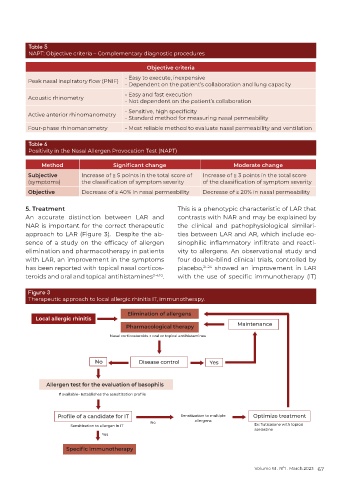
Table 5
          NAPT: Objective criteria – Complementary diagnostic procedures

                                                  Objective criteria
                                          - Easy to execute, inexpensive
          Peak nasal inspiratory flow (PNIF)
                                          - Dependent on the patient’s collaboration and lung capacity
                                          - Easy and fast execution
          Acoustic rhinometry
                                          - Not dependent on the patient’s collaboration
                                          - Sensitive, high specificity
          Active anterior rhinomanometry
                                          - Standard method for measuring nasal permeability
          Four-phase rhinomanometry       - Most reliable method to evaluate nasal permeability and ventilation

          Table 6
          Positivity in the Nasal Allergen Provocation Test (NAPT)

               Method                  Significant change                     Moderate change
          Subjective        Increase of ≥ 5 points in the total score of  Increase of ≥ 3 points in the total score
          (symptoms)        the classification of symptom severity  of the classification of symptom severity
          Objective         Decrease of ≥ 40% in nasal permeability  Decrease of ≥ 20% in nasal permeability

          5. Treatment                                      This is a phenotypic characteristic of LAR that
          An accurate distinction between LAR and           contrasts with NAR and may be explained by
          NAR is important for the correct therapeutic      the clinical and pathophysiological similari-
          approach to LAR (Figure 3).  Despite the ab-      ties between LAR and AR, which include eo-
          sence  of  a  study  on  the  efficacy  of  allergen   sinophilic  inflammatory  infiltrate  and  reacti-
          elimination and pharmacotherapy in patients       vity to allergens. An observational study and
          with LAR, an improvement in the symptoms          four double-blind clinical trials, controlled by
          has been reported with topical nasal corticos-    placebo, 21-24   showed  an  improvement  in  LAR
          teroids and oral and topical antihistamines 3-4,10 .   with  the  use  of  specific  immunotherapy  (IT)


          Figure 3
          Therapeutic approach to local allergic rhinitis IT, immunotherapy.


                                                                                     Volume 61 . Nº1 . March 2023 67

