


Page 65 - Portuguese Journal - SPORL - Vol 61. Nº1
P. 65
(3 weeks), and tricyclic antidepressants (1 week) 19-20 .  a) Conditions of the test room
          The solution used in the NAPT is composed of an   The patients should be adjusted to the
          allergen extract at a predefined concentration,   conditions of the room where the NAPT will be
          diluted in an isotonic solution at neutral pH 19-  performed for 15-30 minutes before the start of
                          18
          20 . Rondón  et al.  established a NAPT protocol   the test. The room should be at a temperature
          with multiple allergens, in which they used the   of 20+/-1.5 ºC with humidity between 40% and
          following concentrations of the aeroallergens     60% 15,19-20 .
          most commonly associated with LAR: solutions
          of  Dermatophagoides pteronyssinus at 4 µm/       b) Qualified staff and emergency medication
          mL,  Alternaria alternata  at 0.25 µm/mL,  Olea   The patients should sign an informed consent
          europaea at 0.6 µm/mL, and grasses at 0.1 µm/     form before undergoing the NAPT. The site
          mL.                                               of the test should be located at less than a
                                                            30-minute distance from an emergency room
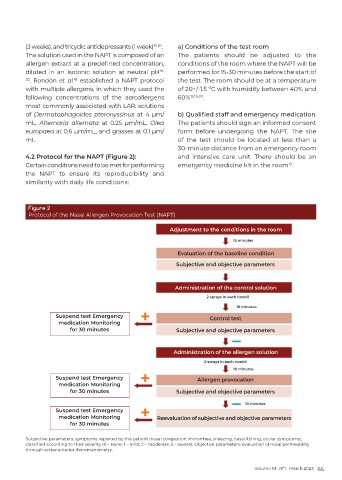
          4.2 Protocol for the NAPT (Figure 2):             and intensive care unit. There should be an
          Certain conditions need to be met for performing   emergency medicine kit in the room .
                                                                                                 19
          the NAPT to ensure  its  reproducibility  and
          similarity with daily life conditions:


          Figure 2
          Protocol of the Nasal Allergen Provocation Test (NAPT)


          Subjective parameters: symptoms reported by the patient (nasal congestion, rhinorrhea, sneezing, nasal itching, ocular symptoms),
          classified according to their severity (0 – none; 1 – mild; 2 – moderate; 3 – severe). Objective parameters: evaluation of nasal permeability
          through active anterior rhinomanometry.


                                                                                     Volume 61 . Nº1 . March 2023 65

