


Page 57 - Portuguese Journal - SPORL - Vol 61. Nº1
P. 57
procedure and control polysomnography              Table 1
          after  the surgery were selected. Patients         Pre-surgery data
          with incomplete data, those who underwent            Variable             N (total = 15)
          multiple surgical interventions (multilevel        Male/Female                13/2
          surgery), and those who did not undergo
          control polysomnography were excluded.             Age          47 years (min. 35 – max. 69) (SD 8.19)
          A total of 15 patients were evaluated. The         Weight        85.92 kg (SD 2.47) (CI 80.47–91.37)
          following variables were analyzed (before          AHI            17.58/h (SD 2.6) (CI 11.86–23.65)
          and after the surgical intervention): AHI, ODI,    ODI            19.73/h (SD 2.02) (CI 15.27–24.19)
          SpO min, ESS scores, and body weight. This         SpO min       80.33% (SD 1.85) (CI 76.24–84.41)
              2
          assessment was performed during a period of           2
          three to six months after the surgery.             ESS              8.75 (SD 1.10) (CI 6.31–19.50)
          Descriptive statistical analysis of the sample    Abbreviations:  AHI, apnea-hypopnea index; ODI, oxygen
                                                            desaturation index; SpO2min, minimum peripheral oxygen
          was performed using the IBM SPSS Statistics       saturation; ESS, Epworth Sleepiness Scale; SD, standard deviation;
          25 software . The significance level was set at   CI, confidence interval.
          5% (p<0.05).                                      score, which decreased from 8.75 (SD 1.1) to 6.5
                                                            (SD 1.01) (p=0.015). There were no statistically
          Results                                           significant differences between the SpO min
                                                                                                     2
          Thirteen of the 15 patients (86.6%) included      before (80.33%, SD 1.85) and after the surgery
          in the  study were men, and only two (13.4%)      (85.22%, SD 1.56) (p=0.089), nor between the
          were  woman.  The  mean  age  was  47 years       weight before (85.92 kg) and after (85.86 kg)
          (minimum 35 years, maximum 69 years,              the surgery (p=0.862).
          standard deviation [SD]  8.19). At the time of    Table 3 lists the results of the tests of association
          diagnosis, the mean weight of the patients        for the analyzed variables before and after the
          was  85.92  kg  (95%  confidence  interval  [CI]   surgery.
          80.47–91.37, SD 2.47), mean AHI was 17.58/h
          (95%  CI 11.86–23.65,  SD  2.6), mean  ODI  was   Discussion
          19.73/h (95% CI 15.27–24.19, SD 2.02), SpO min    In  this  study,  there  was  a  statistically
                                                   2
          was 80.33 % (95% CI 76.24–84.41, SD 1.85), and    significant  improvement  in  the  AHI,  ODI,
          the mean ESS score was 8.75 (95% CI 6.31–19.50,   and daytime sleepiness after nasal surgery.
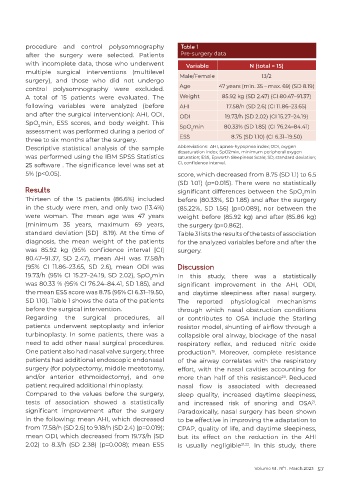
          SD 1.10). Table 1 shows the data of the patients   The reported physiological mechanisms
          before the surgical intervention.                 through  which  nasal  obstruction  conditions
          Regarding the surgical procedures, all            or contributes to OSA include the Starling
          patients  underwent  septoplasty  and  inferior   resistor model, shunting of airflow through a
          turbinoplasty. In some patients, there was a      collapsible oral airway, blockage of the nasal
          need to add other nasal surgical procedures.      respiratory  reflex,  and  reduced  nitric  oxide
          One patient also had nasal valve surgery, three   production . Moreover, complete resistance
                                                                       19
          patients had additional endoscopic endonasal      of the airway correlates with the respiratory
          surgery (for polypectomy, middle meatotomy,       effort,  with  the  nasal  cavities  accounting  for
          and/or anterior ethmoidectomy), and one           more than half of this resistance . Reduced
                                                                                              20
          patient required additional rhinoplasty.          nasal  flow  is  associated  with  decreased
          Compared to the values before the surgery,        sleep  quality,  increased  daytime  sleepiness,
          tests of association showed a statistically       and increased risk of snoring and OSA .
                                                                                                        21
          significant  improvement  after  the  surgery     Paradoxically, nasal surgery has been shown
          in the following: mean AHI, which decreased       to be effective in improving the adaptation to
          from 17.58/h (SD 2.6) to 9.18/h (SD 2.4) (p=0.019);   CPAP, quality of life, and daytime sleepiness,
          mean ODI, which decreased from 19.73/h (SD        but its effect on the reduction in the AHI
          2.02) to 8.3/h (SD 2.38) (p=0.008); mean ESS      is usually negligible 21,22 . In this study, there


                                                                                     Volume 61 . Nº1 . March 2023 57

