


Page 124 - Portuguese Journal - SPORL - Vol 61. Nº1
P. 124
led to the temporary suspension of routine        study which involved the review of the clinical
          hospital activity and changes in the clinical     records of all adult patients (>18 years) with
          management of all patients, including those       an initial diagnosis of HNC in the department
          being considered for priority treatment such as   of otorhinolaryngology (ORL) of the Vila Nova
          cancer patients. In addition to the restrictions   de Gaia/Espinho Hospital Center between
          imposed by the COVID-19 pandemic in terms         September 2018 and September 2021.
          of access to health care services, the fear
          among the population, especially during the       Study variables:
          first pandemic phase, led to a decrease in the    The patients were divided into two groups:
          number of people seeking medical care .           Group A (pre-COVID-19) – patients who started
                                                     5,6
          Thus, there were concerns about possible          treatment before the COVID-19 pandemic
          delays in the diagnosis and start of treatment    (between  September  1,  2018,  and  March  10,
          of patients with HNC. The objective of this study   2020); Group B (post-COVID-19) – patients
          was to compare patients with HNC who were         who started treatment after the start of
          treated in the pre- and post-COVID-19 period      the COVID-19 pandemic (between March 11,
          with regard to the duration of symptoms, time     2020, and September 30, 2021). The analyzed
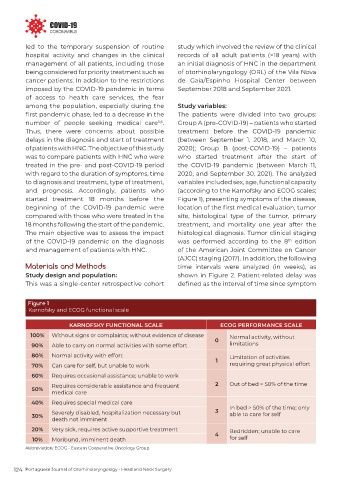
          to diagnosis and treatment, type of treatment,    variables included sex, age, functional capacity
          and prognosis. Accordingly, patients who          (according to the Karnofsky and ECOG scales;
          started treatment 18 months before the            Figure 1), presenting symptoms of the disease,
          beginning of the COVID-19 pandemic were           location of the first medical evaluation, tumor
          compared with those who were treated in the       site, histological type of the tumor, primary
          18 months following the start of the pandemic.    treatment, and mortality one year after the
          The main objective was to assess the impact       histological diagnosis. Tumor clinical staging
          of the COVID-19 pandemic on the diagnosis         was performed according to the  8  edition
                                                                                                 th
          and management of patients with HNC.              of the American Joint Committee on Cancer
                                                            (AJCC) staging (2017).  In addition, the following
          Materials and Methods                             time intervals were analyzed (in weeks), as
          Study design and population:                      shown in Figure 2. Patient-related delay was
          This was a single-center retrospective cohort     defined as the interval of time since symptom


          Figure 1
          Karnofsky and ECOG functional scale

                        KARNOFSKY FUNCTIONAL SCALE                        ECOG PERFORMANCE SCALE
           100%   Without signs or complaints; without evidence of disease   Normal activity, without
                                                                        0
            90%   Able to carry on normal activities with some effort        limitations
           80%    Normal activity with effort                                Limitation of activities
                                                                         1
            70%   Can care for self, but unable to work                      requiring great physical effort
            60%   Requires occasional assistance; unable to work
                  Requires considerable assistance and frequent         2    Out of bed > 50% of the time
            50%
                  medical care
           40%    Requires special medical care                              In bed > 50% of the time; only
                  Severely disabled, hospitalization necessary but      3
            30%                                                              able to care for self
                  death not imminent
            20%   Very sick, requires active supportive treatment            Bedridden; unable to care
                                                                        4
            10%   Moribund, imminent death                                   for self
         Abbreviation: ECOG - Eastern Cooperative Oncology Group


      124  Portuguese Journal of Otorhinolaryngology - Head and Neck Surgery

