


Page 126 - Portuguese Journal - SPORL - Vol 61. Nº1
P. 126
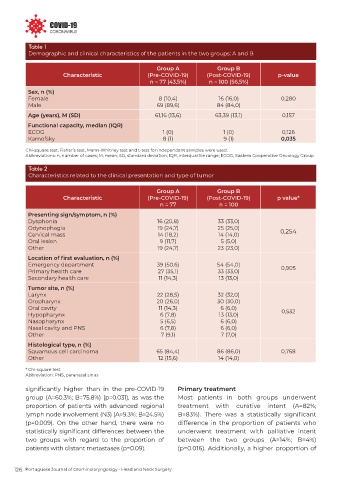
Table 1
          Demographic and clinical characteristics of the patients in the two groups: A and B

                                                     Group A             Group B
                      Characteristic              (Pre-COVID-19)      (Post-COVID-19)        p-value
                                                   n = 77 (43,5%)     n = 100 (56,5%)
          Sex, n (%)
          Female                                      8 (10,4)           16 (16,0)            0,280
          Male                                       69 (89,6)           84 (84,0)
          Age (years), M (SD)                       61,16 (13,6)        63,39 (13,1)           0,157
          Functional capacity, median (IQR)
          ECOG                                         1 (0)               1 (0)              0,126
          Karnofsky                                    8 (1)               9 (1)              0,035
          Chi-square test, Fisher’s test, Mann-Whitney test and t-test for independent samples were used.
          Abbreviations: n, number of cases; M, mean; SD, standard deviation; IQR, interquartile range; ECOG, Eastern Cooperative Oncology Group
          Table 2
          Characteristics related to the clinical presentation and type of tumor

                                                     Group A             Group B
                      Characteristic              (Pre-COVID-19)      (Post-COVID-19)        p value*
                                                      n = 77              n = 100
          Presenting sign/symptom, n (%)
          Dysphonia                                  16 (20,8)           33 (33,0)
          Odynophagia                                19 (24,7)           25 (25,0)
          Cervical mass                              14 (18,2)           14 (14,0)            0,254
          Oral lesion                                 9 (11,7)            5 (5,0)
          Other                                      19 (24,7)           23 (23,0)
          Location of first evaluation, n (%)
          Emergency department                       39 (50,6)           54 (54,0)            0,905
          Primary health care                        27 (35,1)           33 (33,0)
          Secondary health care                       11 (14,3)           13 (13,0)
          Tumor site, n (%)
          Larynx                                     22 (28,5)           32 (32,0)
          Oropharynx                                 20 (26,0)           30 (30,0)
          Oral cavity                                 11 (14,3)           6 (6,0)
          Hypopharynx                                 6 (7,8)             13 (13,0)           0,532
          Nasopharynx                                 5 (6,5)             6 (6,0)
          Nasal cavity and PNS                        6 (7,8)             6 (6,0)
          Other                                       7 (9,1)             7 (7,0)
          Histological type, n (%)
          Squamous cell carcinoma                    65 (84,4)           86 (86,0)            0,768
          Other                                       12 (15,6)          14 (14,0)

          * Chi-square test
          Abbreviation: PNS, paranasal sinus

          significantly  higher  than  in  the  pre-COVID-19   Primary treatment
          group (A=60.3%; B=75.8%) (p=0.031), as was the    Most patients in both groups underwent
          proportion of patients with advanced regional     treatment with curative intent (A=82%;
          lymph node involvement (N3) (A=9.3%; B=24.5%)     B=83%).  There  was  a  statistically  significant
          (p=0.009). On the other hand, there were no       difference in the proportion of patients who
          statistically significant differences between the   underwent treatment with palliative intent
          two groups with regard to the proportion of       between the two groups (A=14%; B=4%)
          patients with distant metastases (p=0.09).        (p=0.016). Additionally, a higher proportion of


      126  Portuguese Journal of Otorhinolaryngology - Head and Neck Surgery

