


Page 119 - Portuguese Journal - SPORL - Vol 61. Nº1
P. 119
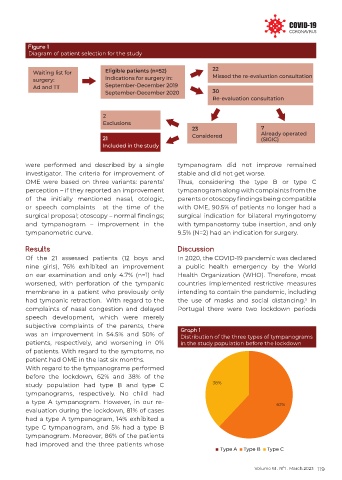
Figure 1
          Diagram of patient selection for the study


          were  performed  and  described  by  a  single    tympanogram did not improve remained
          investigator. The criteria for improvement of     stable and did not get worse.
          OME were based on three variants: parents’        Thus, considering the type B or type C
          perception – if they reported an improvement      tympanogram along with complaints from the
          of the initially mentioned nasal, otologic,       parents or otoscopy findings being compatible
          or speech complaints  at the time of the          with OME, 90.5% of patients no longer had a
          surgical proposal; otoscopy – normal findings;    surgical indication for bilateral myringotomy
          and tympanogram – improvement in the              with tympanostomy tube insertion, and only
          tympanometric curve.                              9.5% (N=2) had an indication for surgery.

          Results                                           Discussion
          Of the 21 assessed patients (12 boys and          In 2020, the COVID-19 pandemic was declared
          nine girls), 76% exhibited an improvement         a public health emergency by the World
          on  ear examination  and only  4.7%  (n=1) had    Health  Organization  (WHO).  Therefore,  most
          worsened, with perforation of the tympanic        countries implemented restrictive measures
          membrane in a patient who previously only         intending to contain the pandemic, including
          had tympanic retraction.  With regard to the      the use of masks and social distancing.   In
                                                                                                      5
          complaints of nasal congestion and delayed        Portugal there were two lockdown periods
          speech  development,  which  were  merely
          subjective complaints of the parents, there        Graph 1
          was an improvement in 54.5% and 50% of             Distribution of the three types of tympanograms
          patients, respectively, and worsening in 0%        in the study population before the lockdown
          of patients. With regard to the symptoms, no
          patient had OME in the last six months.
          With regard to the tympanograms performed
          before the lockdown, 62% and 38% of the
          study population had type B and type C
          tympanograms, respectively. No child had
          a type A tympanogram. However, in our re-
          evaluation during the lockdown, 81% of cases
          had a type A tympanogram, 14% exhibited a
          type  C  tympanogram,  and  5%  had  a  type  B
          tympanogram. Moreover, 86% of the patients
          had improved and the three patients whose


                                                                                     Volume 61 . Nº1 . March 2023 119

