


Page 79 - Revista Portuguesa - SPORL - Vol 41. Nº2
P. 79
LIPOSARCOMA DE HIPOFARINGE: A PROPÓSITO DE UM CASO.


           DISCUSSION.                                           ' Pleomorphic, they have much greater nu-
                                                                   c|ear pleomorphism, with bizarre giant
              Liposarcomo ot the hipopharynx has a male            cells.
           predilection(9:i ratio), the age range of the         º Dedifierentiated. The concept of this type
           patients is from the fourth to the seventh decades      of liposarcoma was advanced by Evans3
           of lifeº. Most authors include liposarcoma of the       for those tumors containing mixed areas
           pyritorm sinus and larynx in the same category,         of welldifferentiated liposarcoma and
           because of their clinical and pathologic similar-       non-Iipogenic spindle cell or pleomorphic
           ities”. The youngest patient (28 years old) has         sarcoma, with an abrupt transition (figure 3)
           been reported by Shah and Lowry‘2.The lesions           between both areas, either in the primary
           usually involve the hipopharynx and supraglot—          or in the local recurrences. The dedifte—
           tic  |arynx(epig|ottis,  aryteniod  eminence,           rentiated areas may be very difficult to
           aryepiglottic told and false vocal cord), glottis       distiguish from a well differentiated lipo-
           involvement is very infrequent(only two cases           sarcoma, specially in small biopsy sam-
           have been reported to affect the true vocal             ples. There seems to be a straight correla-
           cords). Symptoms consist of hoarseness, dys-            tion between mitotic activity in the dedif-
           phagia and a variable degree of airwoy of               terentiated areas and biological behavi-
           obstruction lasting from several weeks to years.        our of the tumor; although the whole
              Computed tomography and magnetic reso-               prognosis of this tumor is better than that
           nance imaging are very useful in determining            of other deditferentiated sarcomas. Only
           tumor’s location and size, so an effective treat-       2 deditterentiated liposarcomas of this
           ment can be planned?                               area have been discribed in the literature” ‘3.
              Location of the tumor is an important factor
           for the prognosis of the patient, although prog-
           nosis is usually worse in pyritorm sinus than it is
           in larynx, hypopharynx and larynx liposarco-
           mas seem to have better Iong-term outcome
           than in other head and neck sites“.
              The most reliable indicator for the clinical
           behavior of liposarcoma is the degree of dif-
           ferentiation. There are four histologic types,
           according to the differentiation of the lipoblast,
           degree of cellularity and pleomorphism of the
           tumor”:
              . WelI—differentiated, composed of mature-
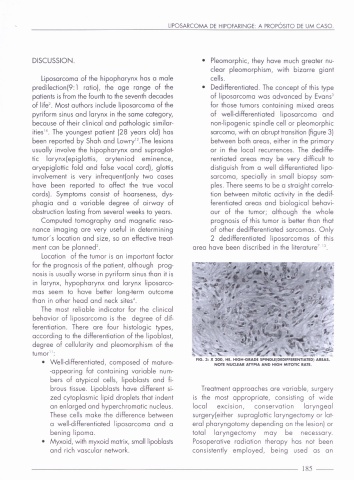
                                                                    NOTE NUCLEAR ATYPIA AND HIGH MITOTIC IATE.
                 -appearing tat containing variable num—
                 bers ot atypical cells, lipoblasts and ti-
                 brous tissue. Lipoblasts have different si-    Treatment approaches are variable, surgery
                 zed cytoplasmic lipid droplets that indent   is the most appropriate, consisting of wide
                 an enlarged and hyperchromatic nucleus.      local  excision,   conservation    laryngeal
                 These cells make the difference between      surgery(either supraglottic laryngectomy or lat-
                 a well-ditferentiated liposarcoma and a      eral pharyngotomy depending on the lesion) or
                 bening lipoma.                               total  laryngectomy   may    be   necessary.
              ' Myxoíd, with myxoid matrix, small lipoblasts  Posoperative radiation therapy has not been
                 and rich vascular network.                   consistently employed, being used as an

                                                                                                185

