


Page 50 - Portuguese Journal - SPORL - Vol 61. Nº1
P. 50
reflects a moderate limitation. Finally, a score   research team (Table 1) after discussions within
         higher than 43 indicates a severe limitation . 1   the focus groups. Regarding the questionnaire
                                                            instructions, the panel of specialists decided
         Results                                            to use the term “tontura” (dizziness) rather
         The original version of the DHI-PC (Figure 1) was   than “tontura/vertigem” (dizziness/vertigo) to
         translated into European Portuguese by two         translate  “dizziness.”  The  maximum  DHI-PC
         independent bilingual translators who were         score in the study population was 72 points.
         independent users of the English language and      This pre-final version was back-translated into
         whose mother tongue was that to which the          the original language by two independent
         DHI-PC was translated (neither translators         bilingual translators who had not seen the
         had medical training). The two translators         original version, had no medical training, and
         and the research team (composed of six             whose mother tongue was that of the original
         otorhinolaryngologists)  together  revised  the    questionnaire. The final consensus version of
         translations  until  reaching  a  consensus  for   the DHI-PC was based on the two translations.
         the  first  version  in  European  Portuguese      The back-translations were sent to the team
         (consensus version of the DHI-PC). The pre-        that developed the original instrument for
         test participants of the focus groups  were        review and formal approval.
         questioned regarding their understanding of
         the items in the questionnaire—dubious or          Discussion
         equivocal  aspects—and  were  asked  to  make      The diagnosis of vestibular disorders is usually
         observations and/or suggestions for changes.       based on the clinical history and symptom
         The discussion among the groups continued          characterization,  which  may  be  difficult
         until no new information was presented. The        in  pediatric  patients  and  can  thus  hinder
         team responsible for the adaptation reached a      diagnosis.
         consensus based on the alterations discussed in    In the adult population, the DHI  has been
                                                                                              11
         the focus groups to achieve semantic, idiomatic,   used to quantify the impact of balance
         experimental, and conceptual equivalence that      disorders and has been translated and
         ensured an accurate translation and adequate       validated in several countries. Validation
         cultural  adaptation.  This  was  the  pre-final   into the Portuguese language and for the
         consensus version of the instrument in             Portuguese     population   was    performed
         Portuguese for use in children and adolescents     by Garcia  et al. in 2008 . The DHI-PC, an
                                                                                      12
         (Figure 2).                                        adaptation for the pediatric population, is
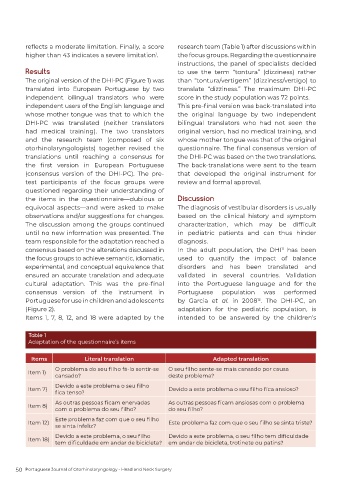
         Items 1, 7, 8, 12, and 18 were adapted by the      intended to be answered by the children’s

          Table 1
          Adaptation of the questionnaire’s items

           Items             Literal translation                        Adapted translation

                   O problema do seu filho fá-lo sentir-se  O seu filho sente-se mais cansado por causa
          Item 1)
                   cansado?                              deste problema?
                   Devido a este problema o seu filho
          Item 7)                                        Devido a este problema o seu filho fica ansioso?
                   fica tenso?
                   As outras pessoas ficam enervadas     As outras pessoas ficam ansiosas com o problema
          Item 8)
                   com o problema do seu filho?          do seu filho?
                   Este problema faz com que o seu filho
          Item 12)                                       Este problema faz com que o seu filho se sinta triste?
                   se sinta infeliz?
                   Devido a este problema, o seu filho   Devido a este problema, o seu filho tem dificuldade
          Item 18)
                   tem dificuldade em andar de bicicleta?  em andar de bicicleta, trotinete ou patins?


      50  Portuguese Journal of Otorhinolaryngology - Head and Neck Surgery

